Abstract
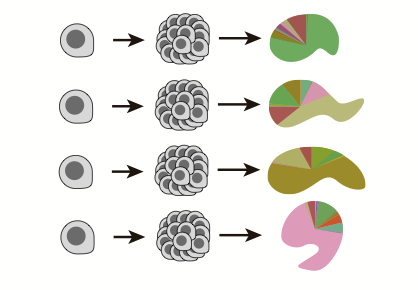
Stem cells self-organize into models of early development, but even under carefully controlled conditions, the resulting organoids exhibit substantial ‘‘inter-individual’’ heterogeneity. To explore its origins, we generated monoclonal gastruloids, each derived from a single mouse embryonic stem cell (mESC). Molecular profiling revealed extensive heterogeneity: some gastruloids failed to develop, others were biased toward mesodermal or neural fates, and yet others contained cell types atypical of conventional polyclonal gastruloids. Applying DNA Typewriter, a cell lineage recorder, we identified heritable fate biases arising prior to gastruloid induction and found that more closely related founder mESCs give rise to more phenotypically similar gastruloids. Linking mESC subclones to their descendants’ fates revealed cryptic, fate-predictive differences in gene expression and chromatin accessibility, including at imprinted, methylation-sensitive loci linked to developmental potency. Intrinsic, heritable fluctuations in mESC state are therefore an important source of organoid heterogeneity, and DNA Typewriter enables high-resolution lineage trees in stem cell models.
One Sentence Summary:
This study shows that human embryonic stem cells can self-organize into embryo-like structures that model key stages of early human development, providing a powerful system for studying embryogenesis and developmental disorders that are otherwise difficult to investigate experimentally.
# equal contribution ** corresponding author