Abstract
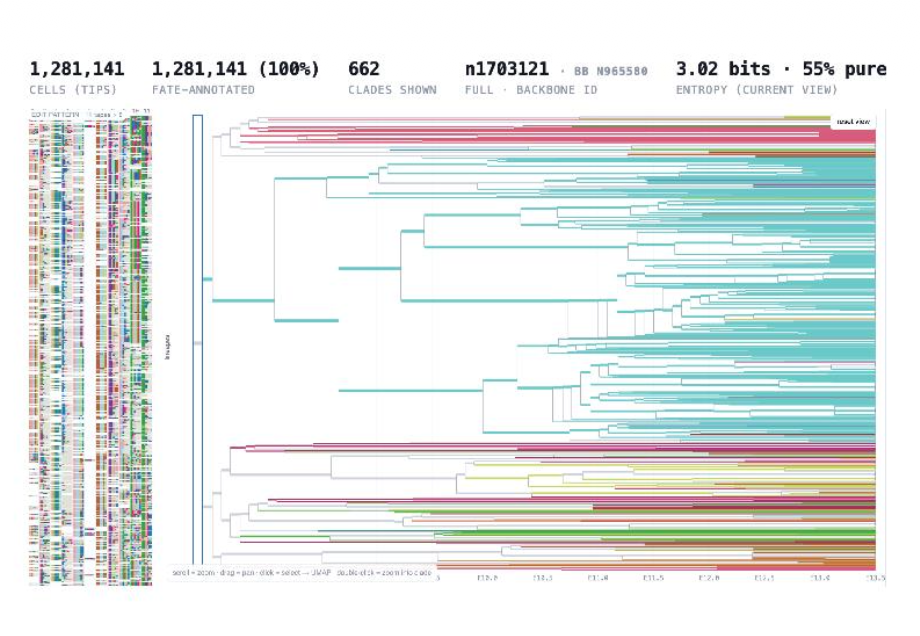
Mammalian biology unfolds over time, within tissues and organs opaque to our eyes and instruments. We applied DNA Typewriter, a sequential molecular recorder, to record the cell lineage of a mouse over nearly two weeks of development. From one embryo, we reconstruct a time-calibrated, parsimony -supported, zygote -rooted phylogeny of 1.28 million transcriptionally profiled cells. A burst of editing unequivocally marks the daughters of the first cleavage, which serve as inline replicates. We quantify clonal dominance arising during gastrulation. Tree siblings share cell type far above chance; heterotypic siblings mark terminal differentiations. Temporal sweeps of clade co -occurrence recover a dated hierarchy of cell-type couplings; imputed labels for internal nodes recapitulate known state paths. A lineage -anchored ontogeny of mammalian development, long out of reach, is coming into view.
One Sentence Summary:
Using DNA Typewriter, the researchers reconstructed the lineage history of 1.28 million cells from a single developing mouse embryo, linking cell ancestry with transcriptional identity to reveal how cell fates and developmental relationships emerge from the zygote through organogenesis.
# equal contribution ** corresponding author